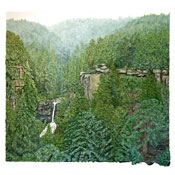
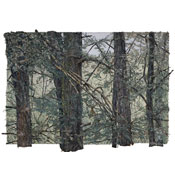
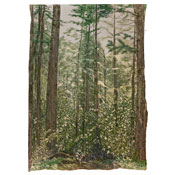
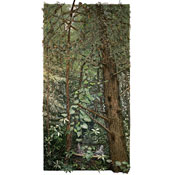
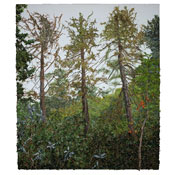
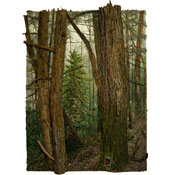
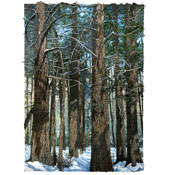
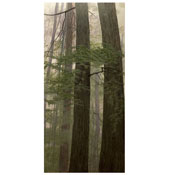
The Hemlocks

Family GroupSnow Frozen OnAmong HemlocksThumbbacklighted Grovenail
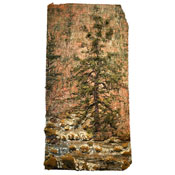
Thumbnail ThumbnailHemlock with Red Lichen

The Hemlocks! The Hemlocks!
Grief and Celebration

Throughout its range, in all but relatively tiny, treated spots, the eastern hemlock has been wiped out. In the Virginias, in all of the north-eastern and Great Lakes states, and through a wide swath across Canada, ghostly gray groves stretch across millions of acres; skeletons stand everywhere among the rhododendrons and hardwoods. I feel as if I am watching and participating in the dying of one who is deeply loved. We have all experienced this, or we will, and the greater our love, the more profound our grief. Hemlock trees are not people, and ultimately their demise cannot be compared to that of a person. Yet, the more spiritually and emotionally we are connected to nature and to life itself, the more deeply we must feel the loss that is now taking place all around us.

We feel that a healthy attitude about death is to know it as a part of life, and this is what we observe in nature. Grieving, we nonetheless celebrate the life of one who dies, appreciating the eventuality of renewal. Extinctions, however, cause severe systemic effects which wreck the finely tuned balance of death and regeneration. Loosing the hemlock, an intimate member of our local living community, makes the ongoing demise of eco-systems immediate and personal.

Confronted with such overwhelming prospects, we are deeply confused. We react in all kinds of ways: denial, panic, attempts to escape, simply returning to a kind of animal innocence, just seeking short-term gratification of our temporal appetites. What, after all, can we do? It seems absurd to think that anything that might be done by one or all of us can make any real difference. Still, when we stop to realize that no event in reality is without connection to the whole, and consequences for the whole, we have to know that it does matter what we do, especially here, in this thin, fragile life zone, Earth’s biosphere. Buying a shrub, saving a tree, learning to care about life-sized issues and living individuals of every life form; all these things matter very much.

Here in the southern limits of the eastern hemlock range, we are the last to be affected by the devastation of the HWA. This means that we still have living trees that can be saved. The video shown with this exhibit outlines some options for what can be done and is being done, albeit not on a scale needed to save most of the oldest, grandest trees still living in our region. No doubt, if the hemlocks became enough of a priority quickly enough, many more could be saved.

The five works of this exhibition are a preview of a large project now in progress which will be completed in 2010. This series of paintings is intended as a celebration of the life and beauty of tsuga canadensis, the eastern hemlock and of the rare tsuga caroliniana, the Carolina hemlock, which occurs only in our region. It is my hope that these exhibitions will connect with viewers spiritually and emotionally, enhancing awareness and deepening the bond with these irreplaceable members of our living community.

Lowell Hayes